Panoramic Structured Parsing
A VLM parses six RGB views and their coordinate-scaffolded counterparts into goal-conditioned, queryable scene records.
IROS 2026
* Equal contribution † Corresponding author
2026 IEEE/RSJ International Conference on Intelligent Robots and Systems (IROS)
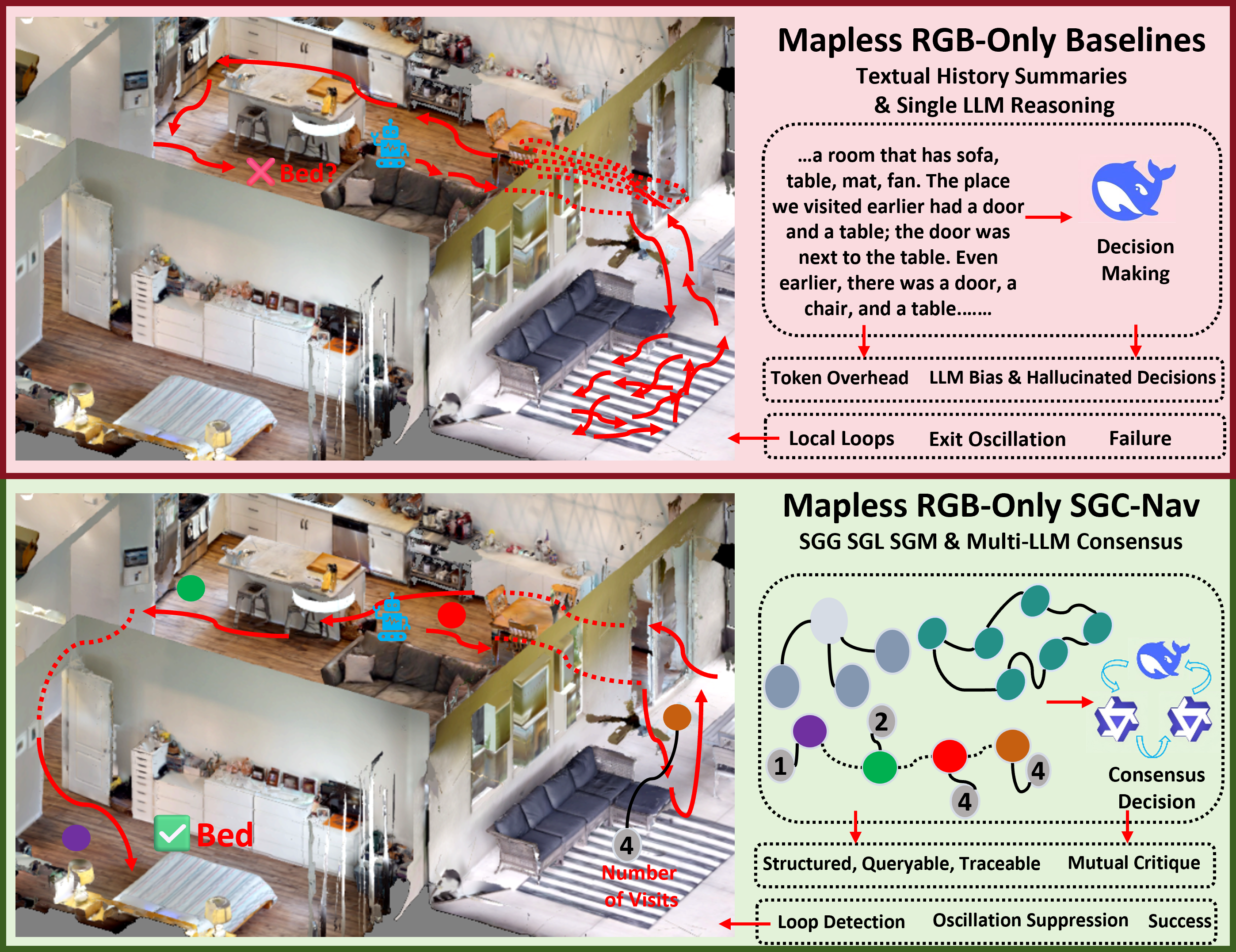
Without a prior metric map, zero-shot open-vocabulary object navigation using only RGB observations remains highly challenging. Existing methods often over-rely on the current observation or encode history as text sequences. This makes topological connectivity, revisit traces, and target-absence cues hard to query and exploit. As a result, robots can suffer from local deadlocks, repeated revisits, and unreliable stopping. To address this, we propose SGC-Nav, a navigation framework that combines structured memory with consensus-based decision-making. SGC-Nav builds scene graphs from RGB observations. It maintains an online scene graph memory that merges revisits, records connectivity, revisit frequency, and absence cues. Building on this structured context, SGC-Nav performs loop-aware multi-LLM consensus with a goal-conditioned stop judge and feasibility correction to stabilize direction selection and termination. On the public navigation benchmark, SGC-Nav achieves higher success rates and greater path efficiency than prior RGB-only, mapless methods. Its effectiveness is further validated through real-robot indoor experiments.
Approach
A mapless, RGB-only pipeline that makes long-horizon navigation history explicit and actionable.
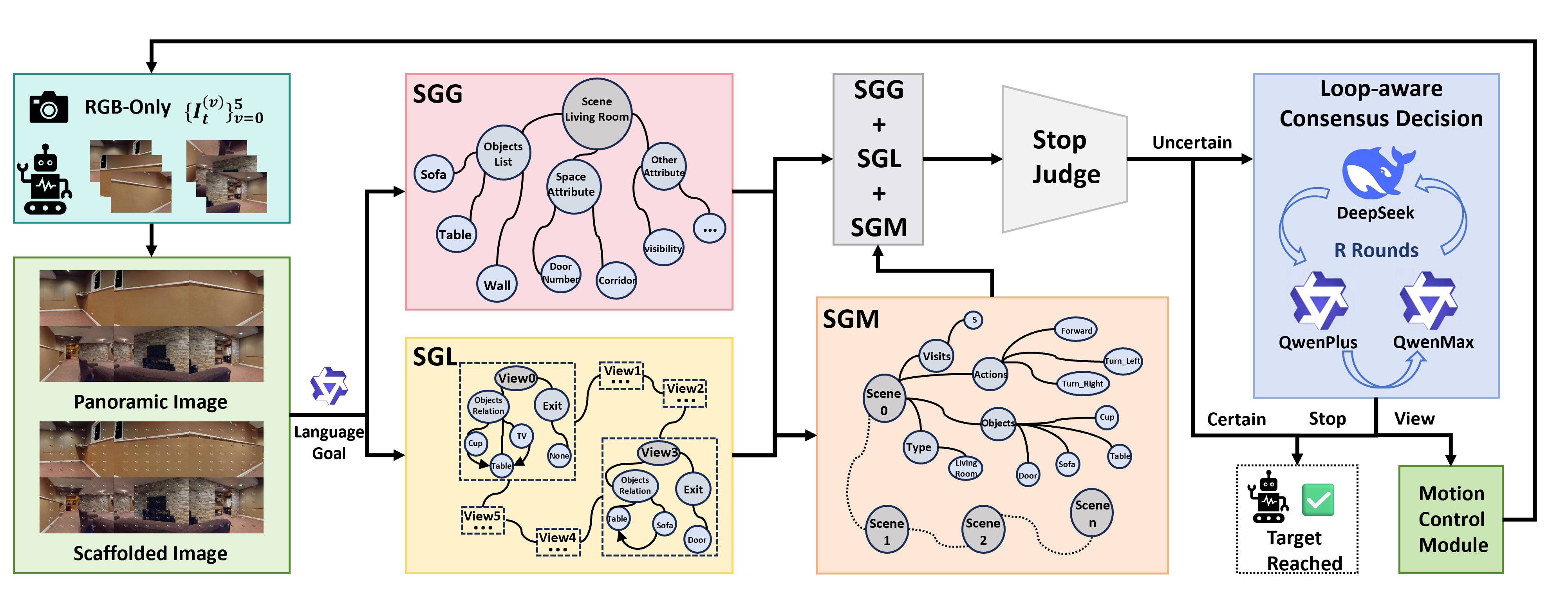
A VLM parses six RGB views and their coordinate-scaffolded counterparts into goal-conditioned, queryable scene records.
SGG captures global semantics, SGL encodes per-view action cues, and SGM maintains connectivity, revisits, and target-absence evidence.
A goal-conditioned stop judge, multi-LLM evidence exchange, and feasibility correction stabilize direction selection and termination.
Evaluation
Strong mapless ObjectNav performance in simulation, with successful transfer to a physical robot.
Success Rate
HM3D ObjectNav
SPL
HM3D ObjectNav
Success Rate
Real-robot trials
Watch
Cite this work
@inproceedings{xue2026sgcnav,
  title     = {SGC-Nav: Scene Graph Conditioned Multi-LLM Consensus for Mapless Zero-Shot Object Navigation},
  author    = {Yikai Xue and Yachao Wang and Yuanqi Qiu and Yinchuan Wang and Yiming Wu and Yue Wang and Chaoqun Wang},
  booktitle = {2026 IEEE/RSJ International Conference on Intelligent Robots and Systems (IROS)},
  year      = {2026}
}